
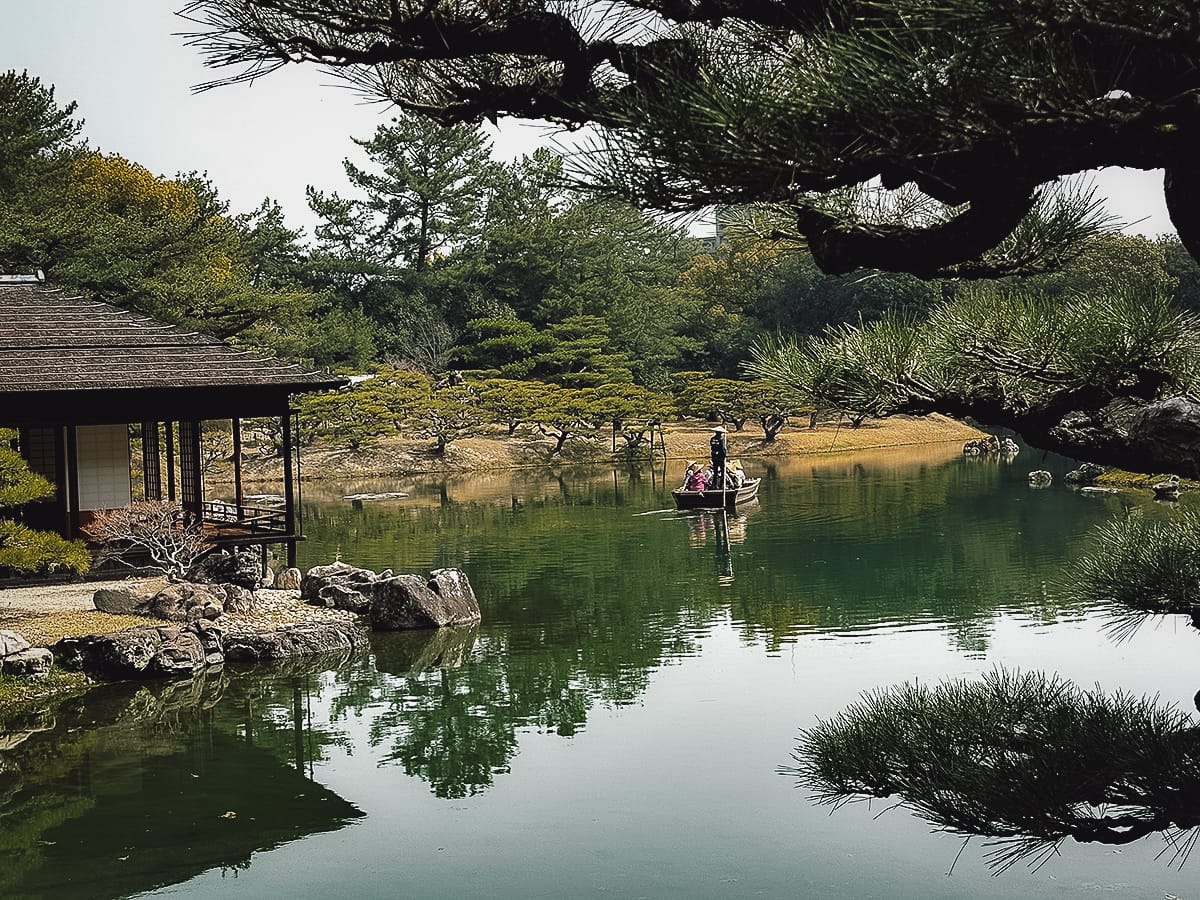
SUMMARY HIGHLIGHTS
- Covering an area of 75 hectares, with 6 ponds and 13 artificial hills, Ritsurin Koen is one of the largest strolling gardens in Japan.
- Ritsurin Koen is designated as a Special Place of Scenic Beauty and a National Treasure of Japan. It was also awarded the highest rating of three stars by the Michelin Green Guide Japan.
I thought two hours would be more than enough. I had been to many landscaped gardens throughout Japan, and two hours was always enough time for even the biggest gardens like Kenrokuen in Kanazawa or Korakuen in Okayama.
Coming from Okayama City and needing to catch a ferry to Ogijima immediately after, I was confident I had allocated enough time. It was just another garden after all. How much time could I possibly need?
As it turns out, Ritsurin Koen wasn’t just another garden. Framed by the verdant Mt Shiun, it’s one of the largest and most spectacular strolling gardens in Japan. There was so much to see (and photograph) that two plus hours felt like barely enough time, and it wasn’t. Needing to stay on schedule to catch a ferry, I wound up rushing through sections and vowing to come back another time.
Before that day, Kenrokuen was the most impressive garden I had visited in Japan. After Ritsurin Koen, I could only wonder why it’s never been included in the country’s so-called “big three”.
VISIT TAKAMATSU QUICK LINKS
To help you with your Takamatsu trip planning, we’ve compiled links to top-rated hotels, tours, and other travel-related services here.
HOTELS
Recommended hotels around Takamatsu Station, the most convenient place to stay for first-time visitors to Takamatsu.
- Luxury: JR Hotel Clement Takamatsu
- Midrange: WeBase TAKAMATSU
- Budget: Hostel JAQ takamatsu
EXPERIENCES
- Garden Tour: Ritsurin Garden Guided Walking Tour
- Sightseeing Tour: Private Customizable Takamatsu Tour with Local Guide
- Cooking Class: Udon Noodle Luxury Bus Tour With Cooking Class
OTHER SERVICES
- Travel Insurance (non-US residents get 5% off)
- JR West Kansai Wide Area Pass
- Japan Rail Pass
- Japan eSIM
History of Ritsurin Koen
According to the pamphlet they give you upon entry, construction for Ritsurin Koen (Ritsurin Garden) began in 1625, under the guidance of Ikoma Takatoshi, Takamatsu’s feudal lord at the time. Construction started around Nanko Pond of the present-day garden.
In 1642, Matsudaira Yorishige continued the garden’s construction after taking control of the province. He and successive members of his clan continued developing the garden for over a hundred years until its completion in 1745, under the rule of Matsudaira Yoritaka, the domain’s fifth lord.
The garden was used as the Matsudaira family’s villa for 228 years before it was opened to the public in 1875. In 1953, the Japanese government designated Ritsurin Koen as one of the country’s Special Places of Scenic Beauty. It was also awarded three stars by Michelin Green Guide Japan in 2009.
In spite of its accolades, Ritsurin Koen isn’t considered one of the Three Great Gardens of Japan.
Visiting Ritsurin Koen
The moment you walk into Ritsurin Koen, you’ll realize this is no ordinary garden.
Located in front of the wooded Mt Shiun, the garden’s total area is roughly 75 hectares (750,000 sq m). It’s home to six ponds and thirteen artificial hills distributed between two sections, the north and south gardens.
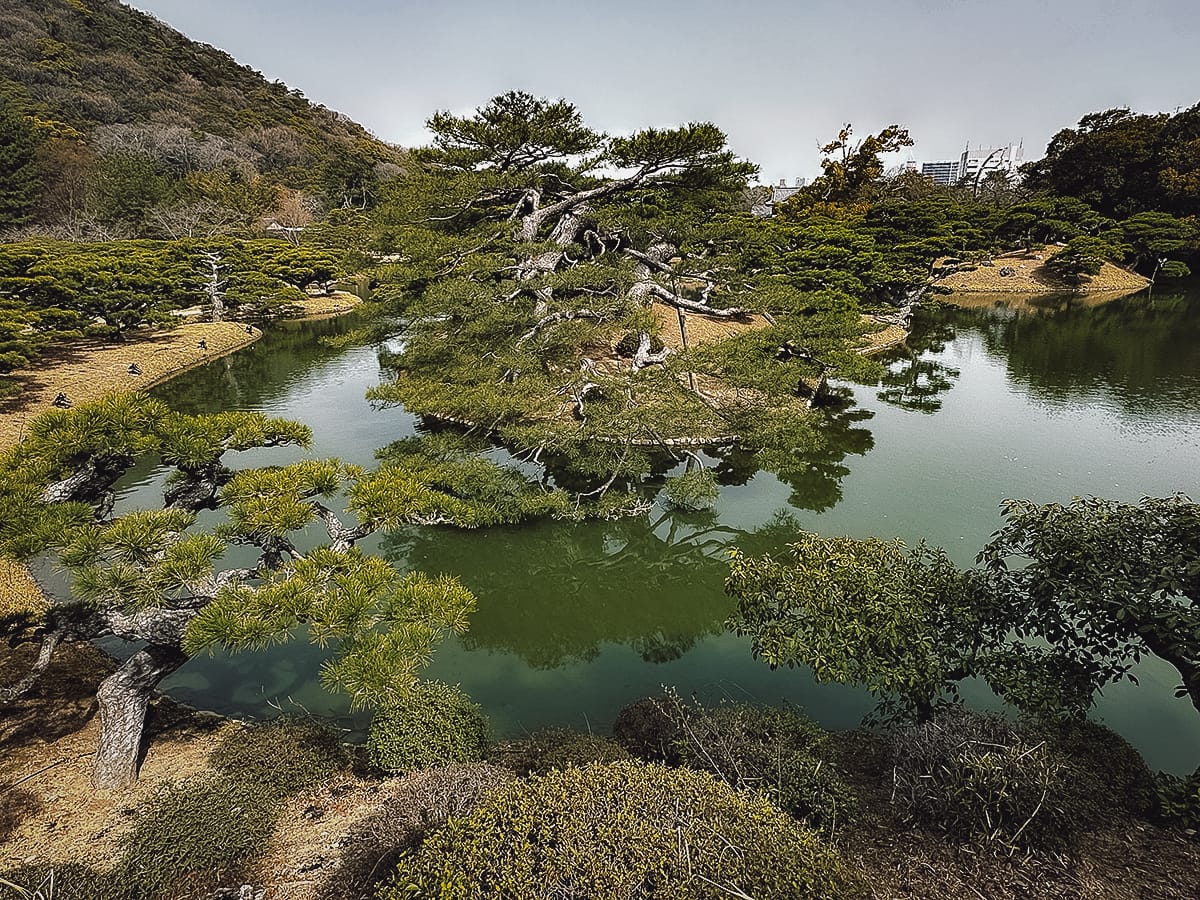
Of all the flora at Ritsurin Koen, it’s clear that the pine trees are a particular source of pride. Calling them the “best pine trees in Japan“, they’ve been meticulously caring for the roughly 1,000 pines at the garden for over 300 years. Many, like the trees you see below, have branches beautifully curved like bonsai.
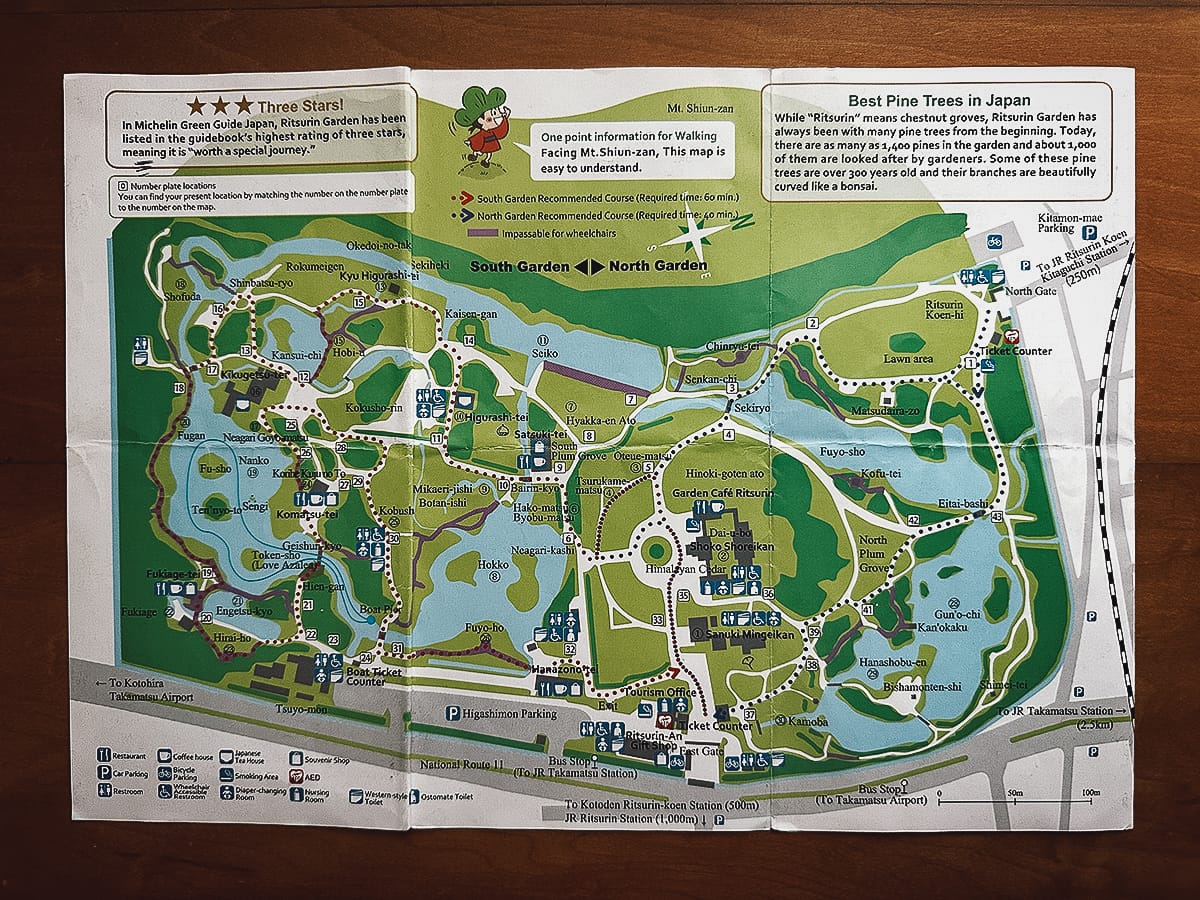
Unlike other Japanese gardens I’ve visited, where you’re pretty much left to explore the garden on your own, Ritsurin Koen gives you a map with two clearly marked walking trails to follow. This is a godsend because it shows you the ideal path to take to explore the garden’s grounds, so you don’t miss anything.
One walking trail is for the South Garden, while the other takes you through the North. They take roughly 60 minutes and 40 minutes to complete, respectively.
Both sections are beautiful, but clearly, the South Garden is the primary draw at Ritsurin Koen. If you have limited time, then I recommend starting there.
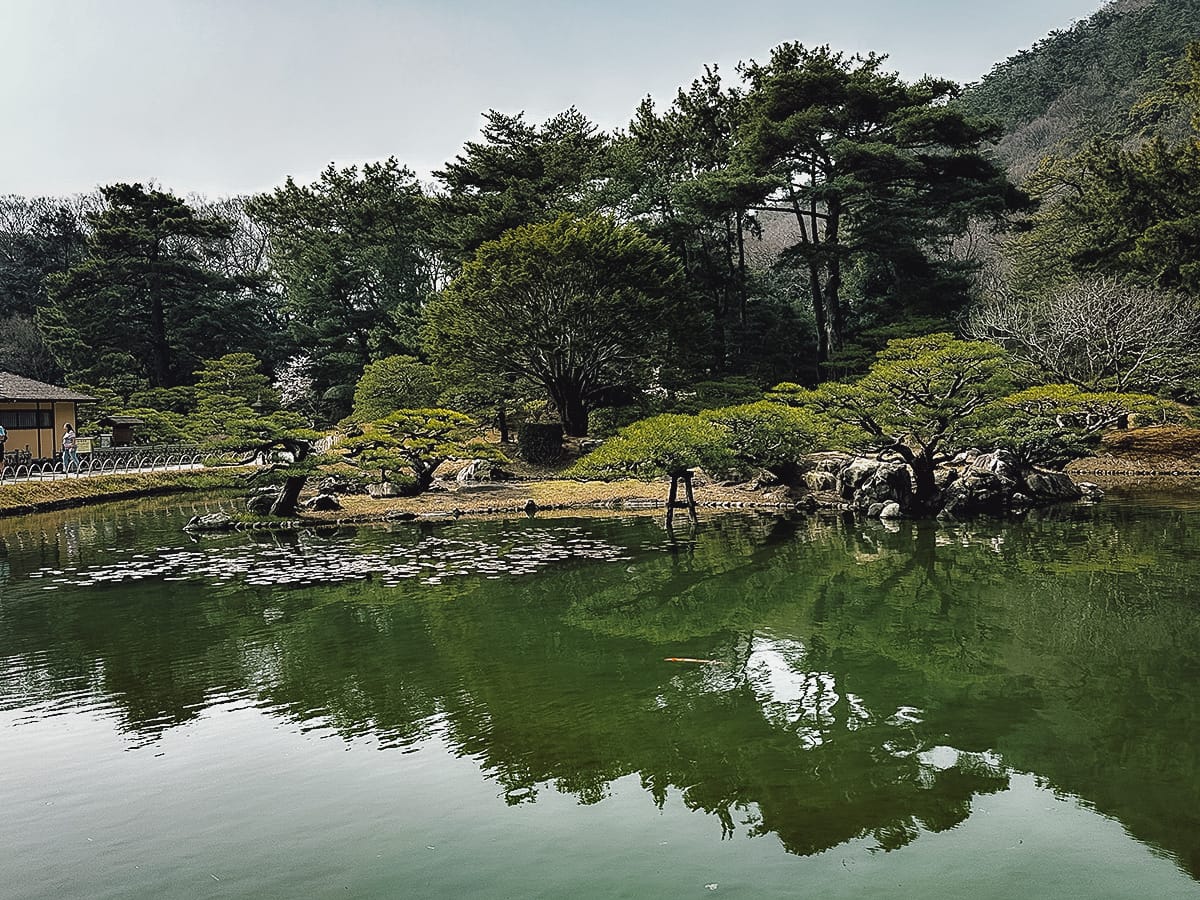
The southern portion is the oldest part of the garden and is done in the traditional Japanese style. It’s home to two teahouses and numerous bonsai-like shaped pine trees. When Ritsurin Koen was opened to the public in 1875, the northern portion was redesigned in the Western style1.
A museum dedicated to local traditional crafts, Sanuki Mingeikan (formerly the Kagawa Prefecture Museum), was also erected in the northern garden.
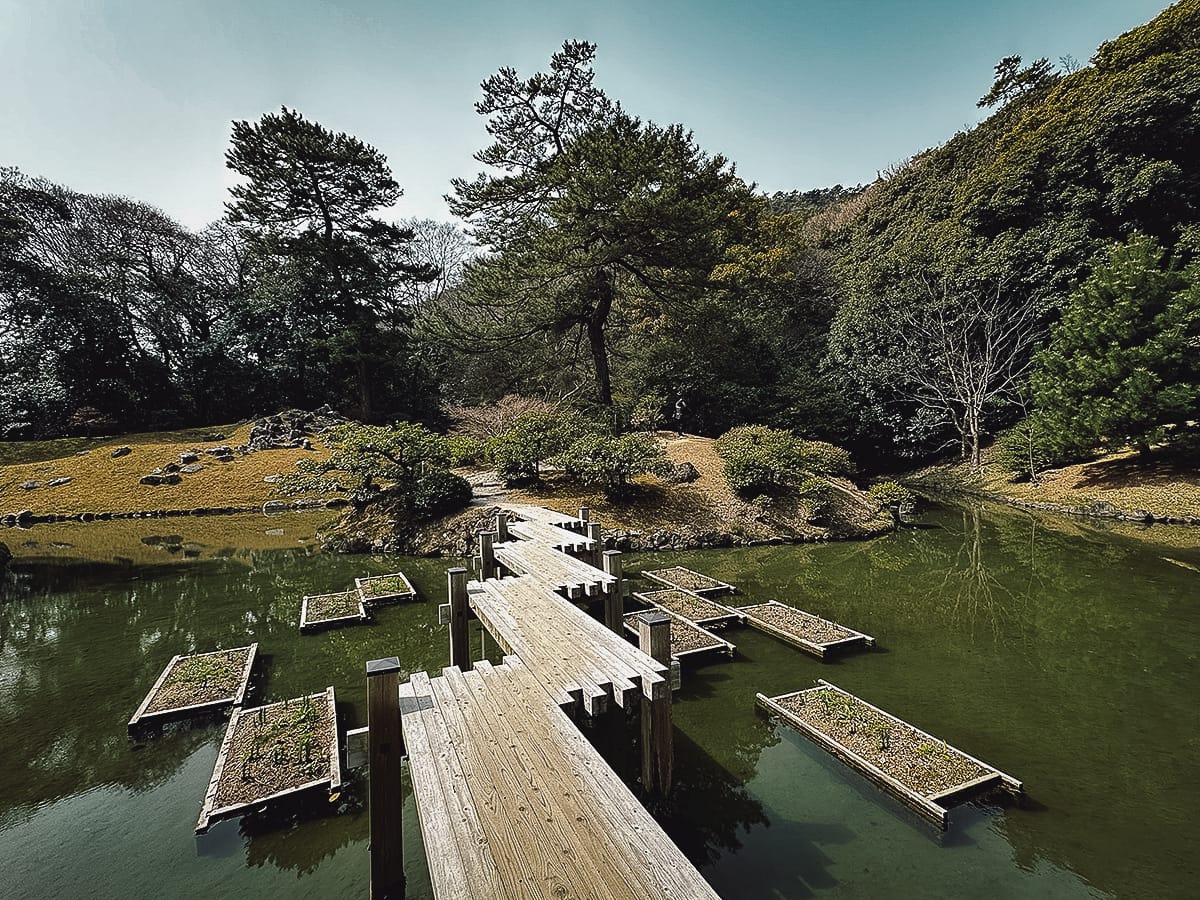
I’ve seen these zig-zag bridges at more than one Japanese garden. I used to think they were made to resemble shide, those zig-zag-folded paper streamers you often see at Shinto shrines, but that isn’t the case.
Curious about the design, I read up on it and came across a popular explanation rooted in folklore – evil spirits can only travel in straight lines. According to this theory, a zig-zag bridge repels or confuses evil spirits, thereby protecting the garden. Apparently, this is also untrue2.
These zig-zag bridges are known as yatsu-hashi, meaning “eight bridges”. This is in reference to the eight planks of wood used to create each segment of the bridge. According to the Rohoen website, they’re designed in a zig-zag shape to allow guests to walk over the bridge and admire the scenery from different vantage points.
Rooted in practicality, not folklore, the Japanese really do think of everything.
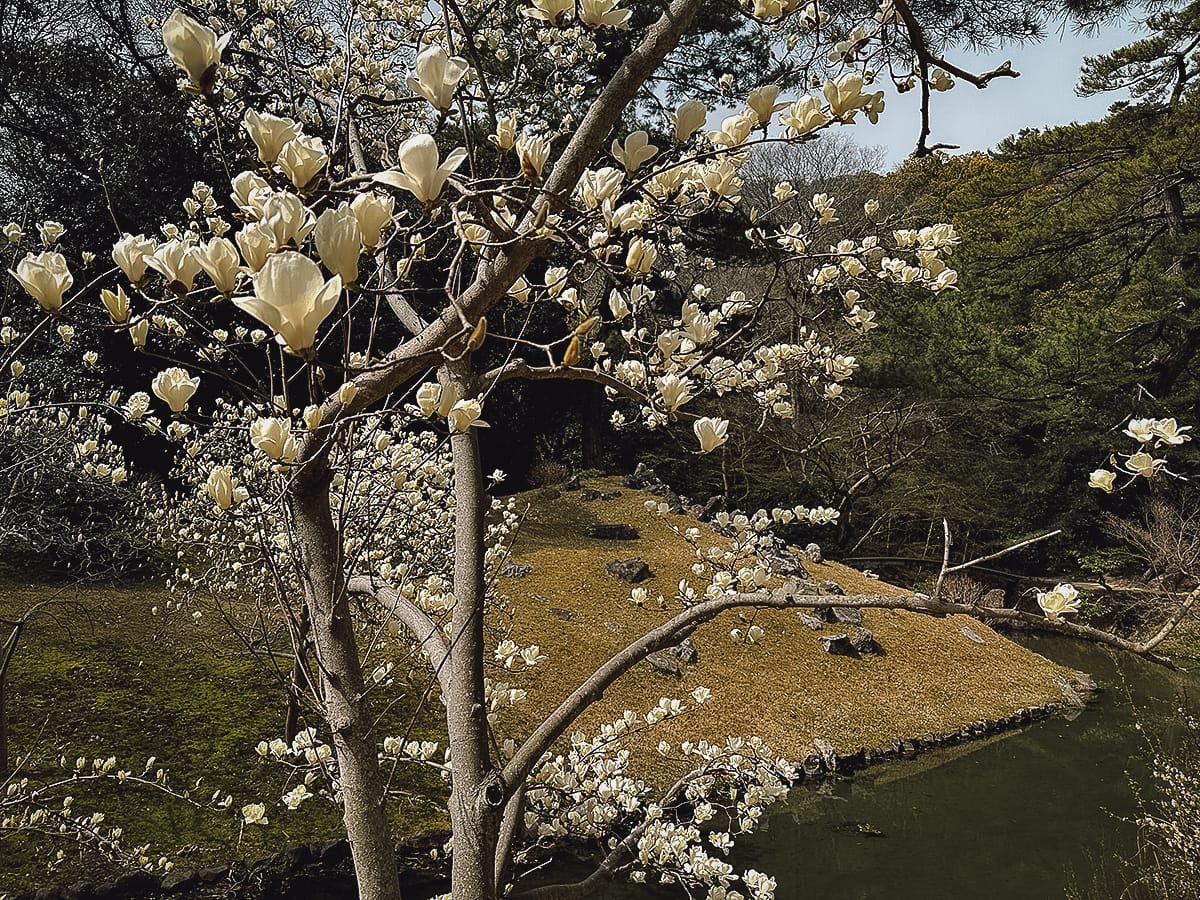
Ritsurin Koen is home to different types of seasonal flowers. I’m not sure if these are cherry blossoms, but according to the Shikoku Tourism website, there are approximately 300 Somei-Yoshino cherry trees at the garden.
Koi ponds are among my favorite features at Japanese gardens. Near this bridge are vending machines that dispense small packets of fish pellets.
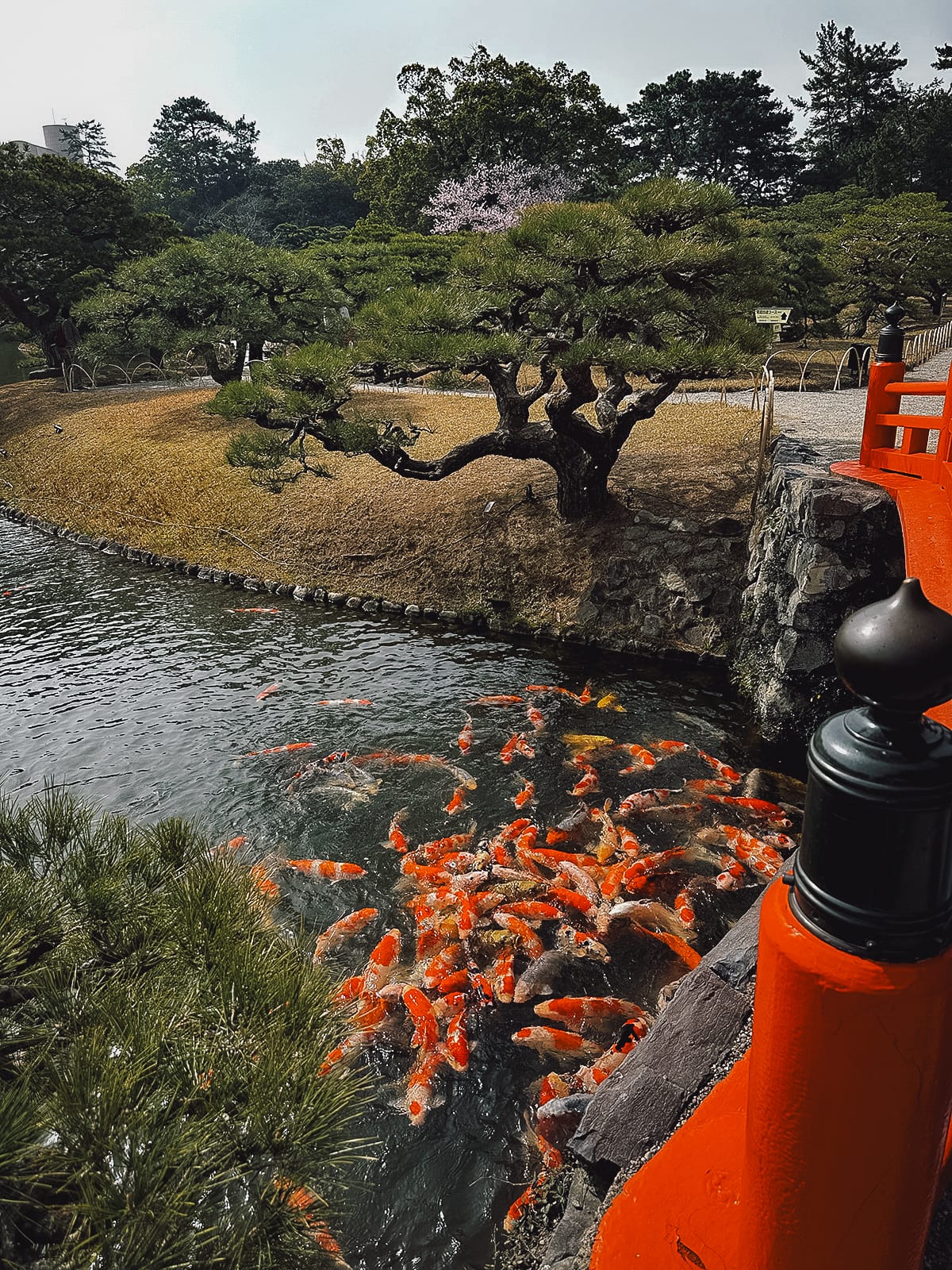
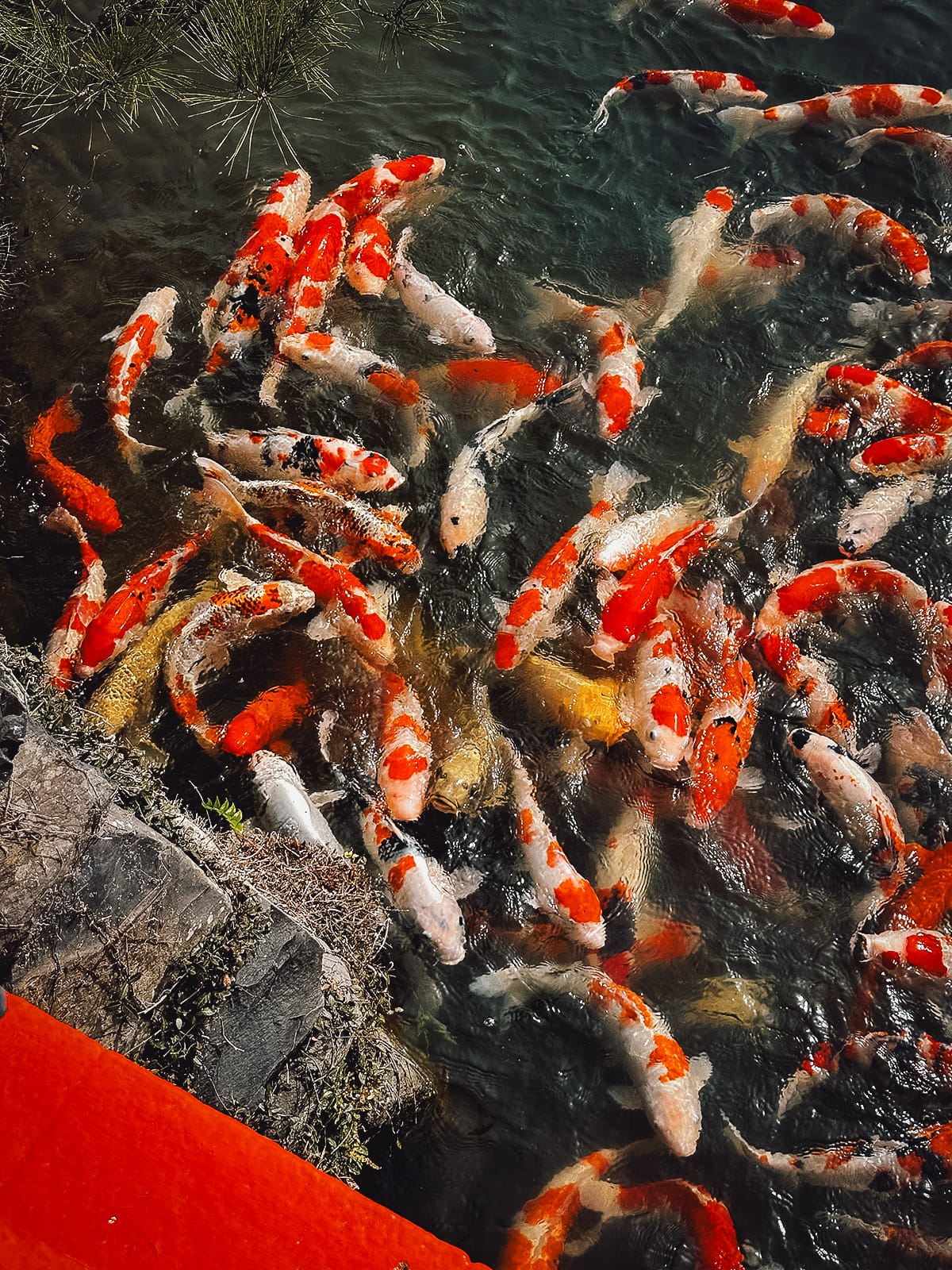
Throw a few pellets into the pond, and you’ll have a colorful picture or Reel to post on Instagram.
This is one of the most spectacular viewpoints in the garden. Known as Hirai-ho Hill, this artificial mound was designed to resemble Mt Fuji and gives viewers a clear view of Engetsu-kyo Bridge and the South Pond with Mt Shiun rising gracefully in the background.
If you time it just right, you may even catch a passing wasen boat gliding through the pond.
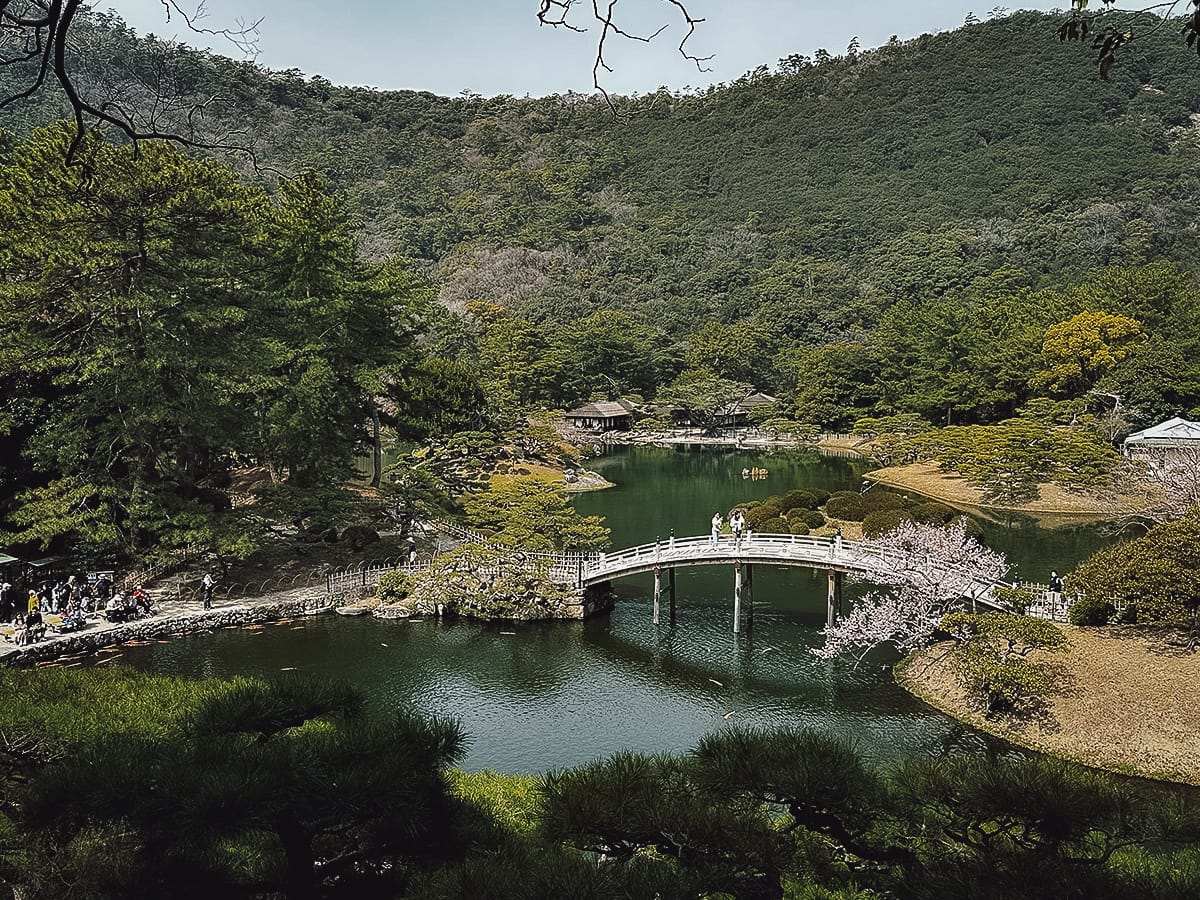
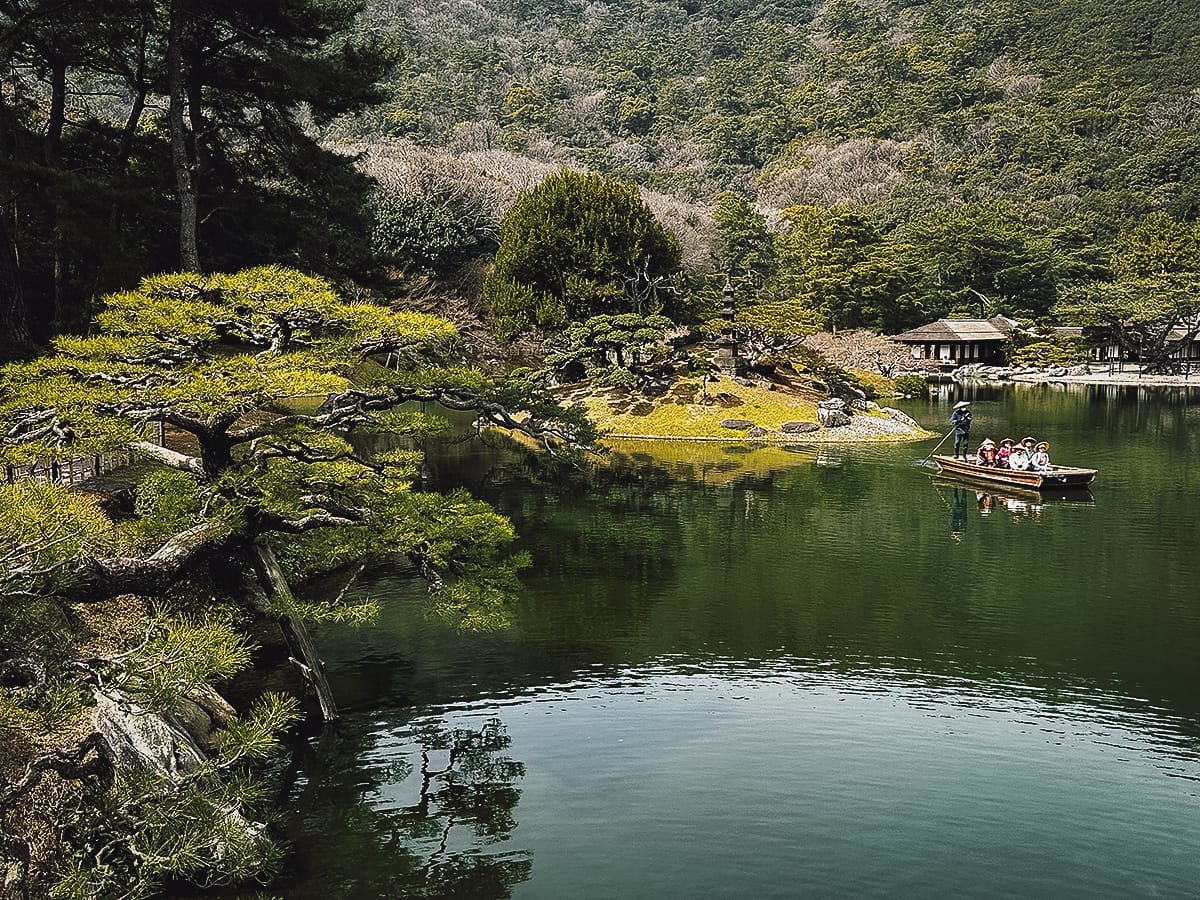
Here, a group of tourists is taken on a loop of the South Pond in a traditional wasen boat, expertly guided by a boatman.
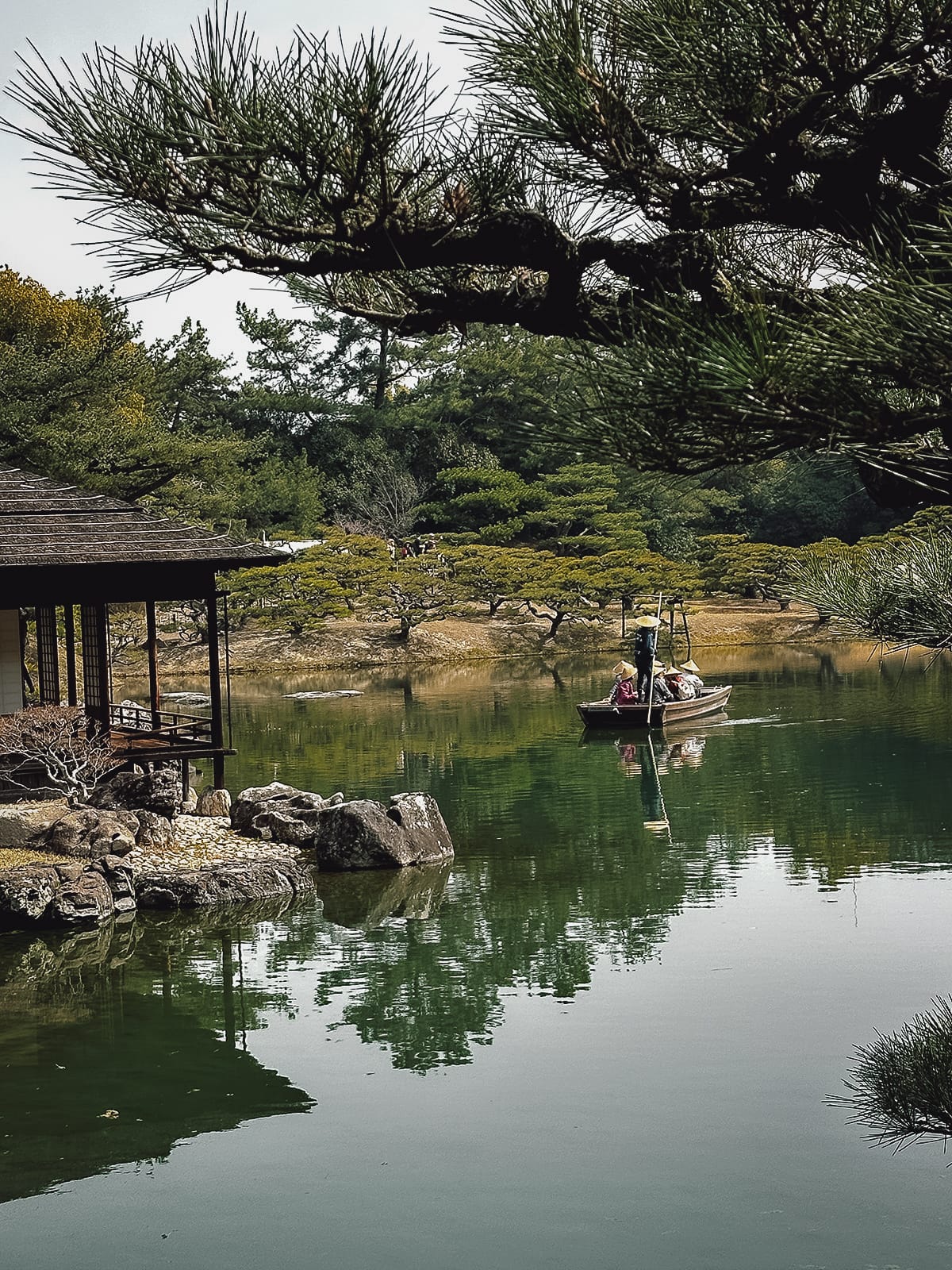
Don’t these Japanese boats make for a picture-perfect scene? Of all the landscaped gardens I’ve been to in Japan, only Ritsurin Koen is large enough to offer these traditional boat rides.
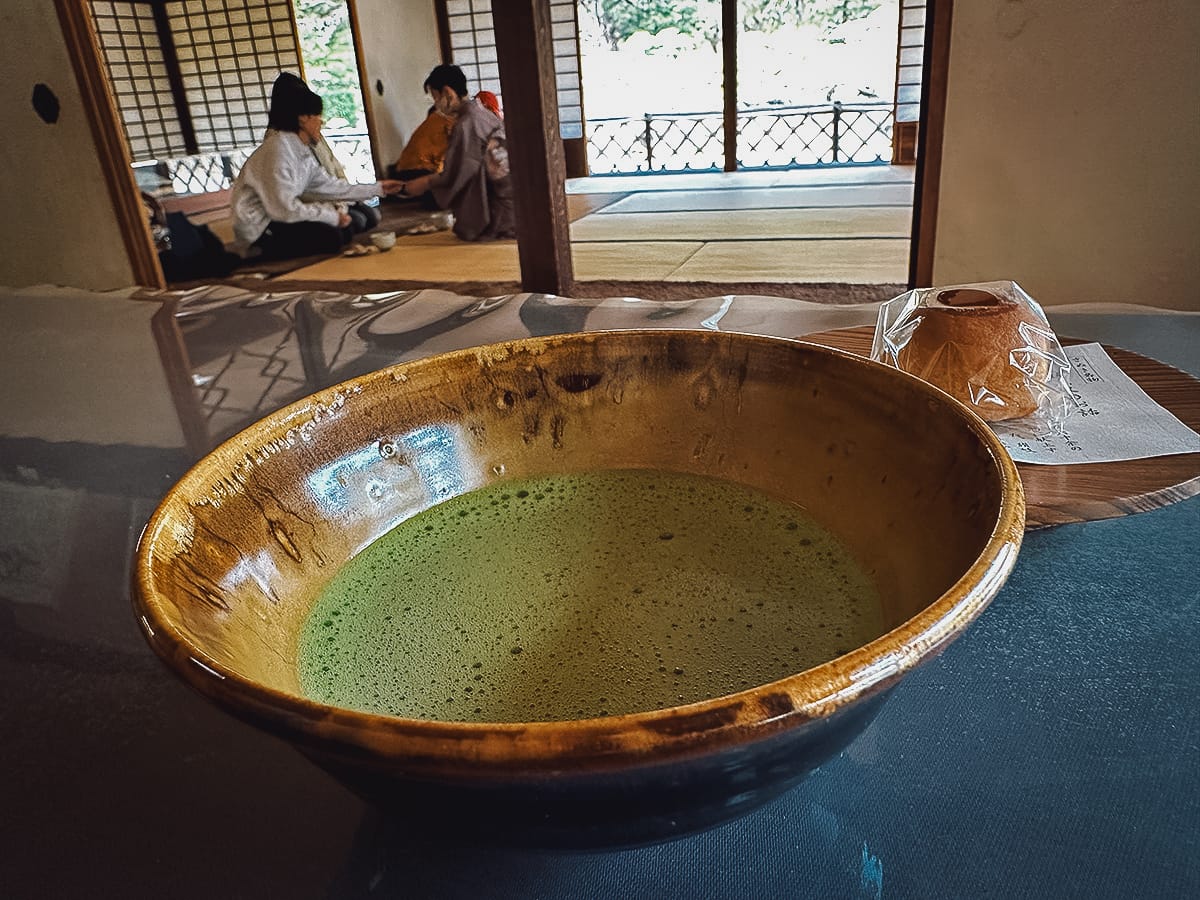
No matter how short I am of time, there’s one thing I never fail to do at Japanese gardens, and that’s to enjoy a bowl of matcha with wagashi. It’s one of my absolute favorite things to do in Japan.
Kikugetsu-tei is the main teahouse at Ritsurin Koen, but you can also enjoy matcha at a smaller teahouse, Higurashi-tei. There are several cafes and gift shops throughout the garden as well.
Visit Ritsurin Koen FAQs
What is the admission fee at Ritsurin Koen?
As of January 2026, admission to Ritsurin Koen is JPY 500 per adult (JPY 170/child). Wasen boat rides are JPY 620 per adult (JPY 310/child).
How do I get to Ritsurin Koen?
Ritsurin Koen is located around 2.5 km (1.6 miles) south of Takamatsu Station. It took me less than half an hour to get there on foot from the station, but you can also take the bus or metro. You can plot your trip using Google Maps.
How much time will I need for my visit?
I got to see everything in a little over two hours, but it did feel a bit rushed. If time weren’t a factor, then I would have preferred to spend at least three hours there.
THE FINAL SAY
I will never grow tired of these Japanese landscaped gardens. For me, they’re an essential part of the Japan experience and something I always prioritize no matter where I am in the country.
In my opinion, even the smallest gardens are worth visiting, but Ritsurin Koen is an absolute must. Don’t miss it on your next trip to Takamatsu and the Shikoku region.
Disclosure
This article on Ritsurin Koen contains affiliate links, meaning we’ll earn a small commission if you make a booking at no additional cost to you. We only recommend products and services that we use ourselves and firmly believe in. We really appreciate your support, as it helps us make more of these free travel guides. Arigato gozaimasu!
References
1. Ritsurin Garden. Wikipedia. (2005, July 20).
2. 10 Japanese Garden Myths. Japanese Friendship Garden of Phoenix. (2023, April 11).
